
| Musicians | Hamid
Drake — drums Kent Kessler — bass Ken Vandermark — tenor sax Joe Morris — guitar |
| Cover and Artwork | 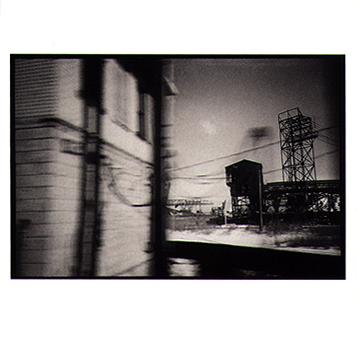 graphic design: L.E. Molnar photography: Rebecca Gleason |
| Songs |
1.
“Standing Here” (12:15) 2. “Bit Tenet” duo #1 (Kessler/Morris) (4:20) 3. “Hollow Curve” trio #1 (Drake/Kessler/Morris) (5:59) 4. “Narrative” (7:33) 5. “Infix” duo #2 (Kessler/Morris) (3:27) 6. “Breathe Easily” trio #2 (Drake/Vandermark/Morris) (4:47) 7. “To and From the Core” trio #3 (Kessler/Vandermark/Morris) (3:17) 8. “Telling” suite (18:35) |
| Recording Info |
recorded
at: Uberstudio Chicago, IL April 30, 1998 recorded
by: Brendan Burke |
| Liner Notes |
I love
the music on this CD, but I wasn’t sure I could describe it even
to myself enough to be able to say something about it. So I listened
to the music many times for days. I thought about how free it was
and yet how fully formed it sounded, as thought we had played as
a quartet for a long time, when in fact we played twice in two days
before we recorded. I noticed how easily the music flowed and how
well it stayed together. The variety of feeling really got me. There’s
something familiar and something different about all of it. I started
thinging about how Hamid Drake, Kent Kessler, Ken Vandermark, and
I figured out how to do this so freely without losing a sense of
shape. How we could use what we know and spontaneously understand
each other.
One
could say that freedom in improvised music may be the ability to
refer to a body of knowledge held in your brain like a language.
It may also mean the opportunity to invent whatever you want, for
whatever reason you can think of. At a certain point, when you’ve workded at learning to improvise for awhile you realize that playing music spontaneously is like talking. Your brain will quickly strip things down to basic information such as how to move, how to sound, how to use energy, how to key into the feel. The elaboration of the combined basics and their variables become your vocabulary. Playing in a group becomes a conversation. The free exchanges of ideas and range of the musical conversation, like a verbal conversation, depends on the knowledge and open-mindedness of the players. The most fluent players have spoken with others in the widest variety of contexts. These players tend to have the most respect for the ideas of others. They can also function with impliesd limits as to where the musical conversation will go, what it will concern itself with, what subject will be discussed. It could simply be said that the accumulation of that kind of musical understanding and the ability to be versatile, at this point, is the equivalent of having a repertoire. If you consider that the scene of new music improvisation, or Jazz as I prefer to call it, is a global one and you want to participate globally, your repertoire has to be extensive. If it is, you’ll have the confidence to play freely. In that respect, and probably many others, DKV Trio has a very extensive repertoire. Their collective knowledge and their originality allows them to work with the rawest materials; the least amount of information necessary to know exactly where to go with the most possibilities. They move forward with a beautiful confidence and openess, inviting collaboration, exploring every sound with curiousity and respect. The slightest musical impulse can become a full-fledged experience. They can turn a hint of sound into melody, a gesture of motion into rich flowing swing. They aren’t afraid to play with a deep sensitivity. More than anything they can find that thing that has been overlooked before, the particle of musical experience not revealed until now. They’ll nurture the particle into a musical whole, a solid form of uniqueness. Playing with them is exciting because you never know what will happen. You have to be prepared for anything. I can’t imagine a more open environment to play in. Fortunately, we and our colleagues are creating music that hasn’t been given a name yet. So we aren’t stuck having to live up to someone else’s description of what we do. We are free to play what we want to play. The music on this recording began with the most basic materials: sound, silence, motion, interval, duration, and emotion. We started to play without any words, written material, or agreed structure and within a couple of minutes we knew it would work. Our agenda seemed to be that we would musically talk to each other. We told each other what we know. We played to make something different, to create another experience for whomever listens. It remains open to personal interpretation, to be described by people who listen. Joe
Morris |
|
Reviews
|
It’s
only a matter of time before Joe Morris and the DKV Trio break through
to a larger audience. Both the DKV (Hamid Drake, drums; Kent Kessler,
bass; Ken Vandermark, tenor saxophone) Trio and Morris have all
the ability to merit such, and the fact that they are not is why
there is no justice in the world. Deep Telling is a mixed bag of
various trio settings, duos, and quartet improvisations. The album
opens with a lengthy "Standing Here," a dense, yet rather accessible
interchange between the Trio plus one. Morris’s angular guitar sits
well with Vandermark’s arrestingly jagged saxophone lines. "Bit
Tenet" and "Infix" mark two maverick duets of bass and guitar. Kessler
and Morris are rejoined by Vandermark for a far more subdued "Narrative,"
perhaps the most interesting of the eight selections. A usually
razor-sharp Vandermark is tested and comes up roses, deliberate
in his remarks and relaxed in his pace. "To and From the Core" is
a guitar/bass/sax trio that features Vandermark at energy levels
comparable to Peter Brötzmann’s invigorating FMP recordings. Perhaps
remaining unsung and underground isn’t a bad thing for Morris and
the DKV Trio. After all, that leaves more for me. — Fred Jung, Editor, Jazz Weekly
I know Ken Vandermark has been a Joe Morris fan since he lived in Boston, and placing Morris alongside the DKV Trio was an inspired move. I enjoyed this collaboration a lot more than the Knitting Factory CD that came out a while ago. The OkkaDisk Fred Anderson/DKV recordings were proof positive that the trio can collaborate with an extra instrumentalist without losing its own identity. Certainly Hamid Drake and Kent Kessler are a fluid rhythm section that Vandermark and Morris can really play together with and off of each other. Like on the end of the first track, “Standing Here”, when the rhythm section fall off and the saxophone and guitar move into an elaborate, interweaving skein of guitar and sax. An entire CD featuring such dense interplay might be too much to handle. The beauty of Deep Telling is that the musical pairings are switched off between all four musicians and a variety of duets and trios. Kent Kessler and Joe Morris duet on two tracks here, both of which are jaw dropping in their lyrical qualities and warmth. As complex as both Morris and Vandermark can get on their respective instruments, Deep Telling also has moments of stark simplicity. The lineup varies across the CD; Kessler, Drake, and Morris play in trio format on “Hollow Curve”, Drake, Vandermark, and Morris work together on “Breathe Easily”, and Kessler, Vandermark, and Morris play together on “To and From the Core”. The entire quartet plays together on three tracks. On “Narrative” Kessler begins on the bass as Drake carefully adds some percussive sounds and Vandermark moves in with a slow, soulful saxophone. At this point you appreciate not only the experience DKV Trio has playing together and what it brought to the recording session, but also the breadth of the Trio’s interests. The match with Joe Morris doesn’t lead to complexity for its own sake. As Morris carefully adds his own melodies to “Narrative” you reach a true understanding of the chemistry of this recording. Deep Telling is yet another excellent OkkaDisk release, an example of how the label continues to match fine improvisers from around the world with sympathetic Chicago musicians. — Bruce Adams, Your Flesh #43 (Spring/Summer 2000) |